

 EN (€EUR)
 Support
  Contact
  My Quote



 Sign in
Teaching cybersecurity today goes far beyond explaining abstract concepts or working with software tools. As automation and connected industrial systems expand, cybersecurity now also applies to physical machines and cyber-physical systems.
In this context, educational robots are becoming essential teaching tools, enabling students to connect academic theory with real operational constraints.
Educating in cybersecurity: a growing academic responsibility
As an educator or program director, you prepare future technicians and engineers to design, deploy and maintain increasingly complex information systems.
These systems must be functional, interconnected and high-performing, but also secure, whether they involve software, networks or physical equipment.
In your courses, you teach core competencies such as:
- Securing IT and electronic systems
- Network and data protection
- Threat detection and system monitoring
- Compliance with industry standards and regulatory frameworks
- Foundations of cyber defense strategies
These modules build on your expertise, field experience and widely adopted professional tools such as Wireshark and Nmap.Ces enseignements reposent sur vos connaissances, votre expérience du terrain et des outils devenus incontournables pour les étudiants, comme Wireshark ou Nmap.
And yet.
When theory alone is no longer enough in real-world environments
During internships or their first professional experiences, students quickly realize that theory is essential — but not sufficient on its own.
In real-world settings, systems are imperfect, interconnected and sometimes poorly documented. Industrial constraints apply, and operational efficiency often outweighs theoretical elegance.
On workshops and production lines, cybersecurity becomes a hands-on operational issue involving real machinery.
Can students be trained for every possible scenario?
Certainly not. And no one claims otherwise.
At NIRYO, however :
👉 We firmly believe that cybersecurity must also be taught using connected physical systems similar to those used in industry.
This conviction led to our educational approach built around the Ned2, a six-axis robotic arm specifically designed for teaching and training.
When cybersecurity moves beyond the screen through an educational robot
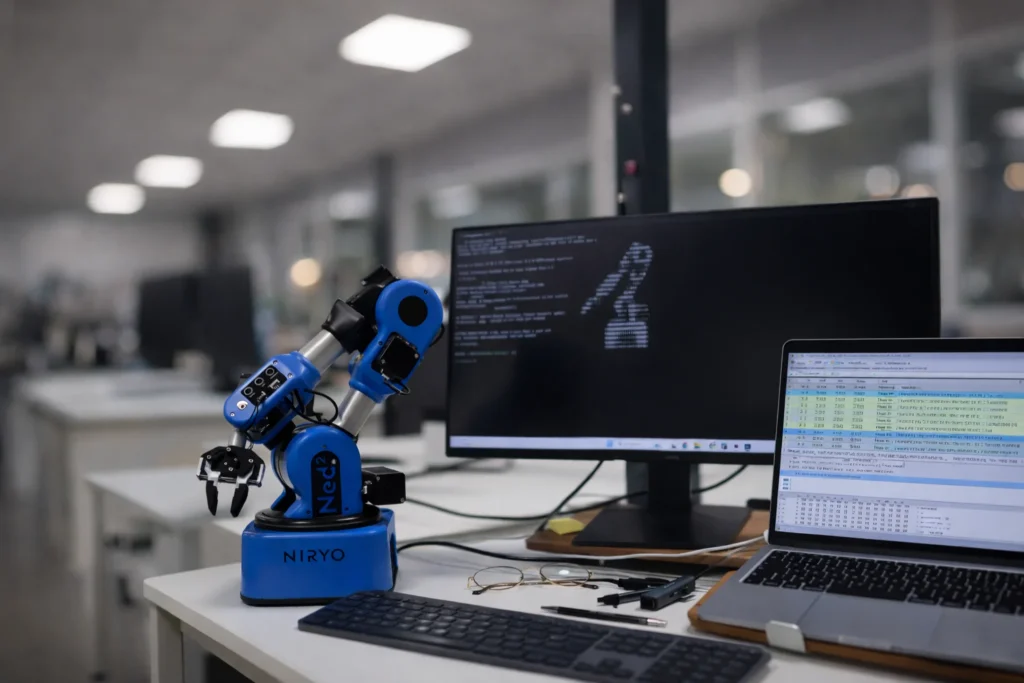
What could be more effective for students than testing their skills on a system that is:
- Real,
- Observable,
- Hands-on and controllable,
- Network-connected,
- And subject to the same constraints as an industrial environment?
he Ned2 is a six-axis robotic arm designed and assembled in France to industrial-grade standards.
Because it doesn’t require a safety cell to operate, this desktop robot fits easily into a wide range of learning environments—from secondary education to higher education and even research labs.
Designed for teaching robotics and robot programming, it enables:
- Quick onboarding thanks to plug-and-play accessories.
- A high level of flexibility thanks to its open-source approach,
- Programming with Blockly or Python, on ROS 2, or through MATLAB/Simulink integrations,
- A practical exploration of the challenges of connected robotic systems—especially in ecosystems built around Siemens, Schneider Electric or Allen‑Bradley.
Despite its industrial-grade build, the Ned2 remains compact (only 7 kg) and priced to equip multiple workstations—where a conventional industrial robot would often limit access and usage.
Add to that highly rated support that is both personal and easy to access, and it’s become one of the most widely adopted collaborative educational robots worldwide (3,500+ units sold).
But just like theory alone, hardware alone isn’t enough.
Collaborative robots in education: why a structured teaching framework matters
No matter how capable it is, a cobot only becomes a real learning asset when it’s embedded in:
- a structured framework,
- clear learning outcomes,
- a progression aligned with students’ levels,
- ready-to-use teaching content that instructors can apply immediately.
That’s why, together with our experts and a panel of specialist instructors, we developed a turnkey curriculum focused on robotics training applied to cybersecurity and networking.
The goal is clear:
👉 enable students to understand, experiment with and secure a real robotic system—just as they will in industry tomorrow.
A teaching program built around four progressive lab sessions
The Cybersecurity & Networking Pack is structured around four lab sessions, each tied to a specific learning objective:
- 🔹 Lab 1 – Exploring a connected robotic system
Understand a robot’s architecture, components and communication flows, along with the basics of securing a physical (cyber-physical) system. - 🔹 Lab 2 – Securing a robot under real-world conditions
Implement concrete security measures on a robot connected to a network. - 🔹 Lab 3 – Protecting data exchanges
Analyze, understand and secure communications between the user, the network and the machine. - 🔹 Lab 4 – Thinking like an attacker
Adopt an offensive mindset to better strengthen the defensive mechanisms of a robotic system.
This approach brings robot programming, network security and industrial cybersecurity together in a coherent, hands-on learning path.
What’s included in the Cyber Pack
The pack includes:
- The Ned2 robot,
- A set of plug-and-play teaching accessories (conveyor, grippers, vacuum pump, electromagnet, vision kit),
- A 3-year NiryoStudio simulation license.
👉 Price: €7,199 (excl. VAT)
👉 Availability: : April 13, 2026
Towards a new way of teaching robotics and cybersecurity
Teaching cybersecurity today means preparing students to secure hybrid systems at the intersection of software, networks and hardware.
With robots designed for education and training, you can:
- Bring teaching closer to industrial realities,
- Strengthen students’ employability,
- Make theoretical concepts feel concrete and relevant.
In a future article, we’ll dive into the full teaching content of these four lab sessions.
In the meantime, if you’d like early information about the training robot and its associated program, our team is here to help.


