

 EN (€EUR)
 Support
  Contact
  My Quote



 Sign in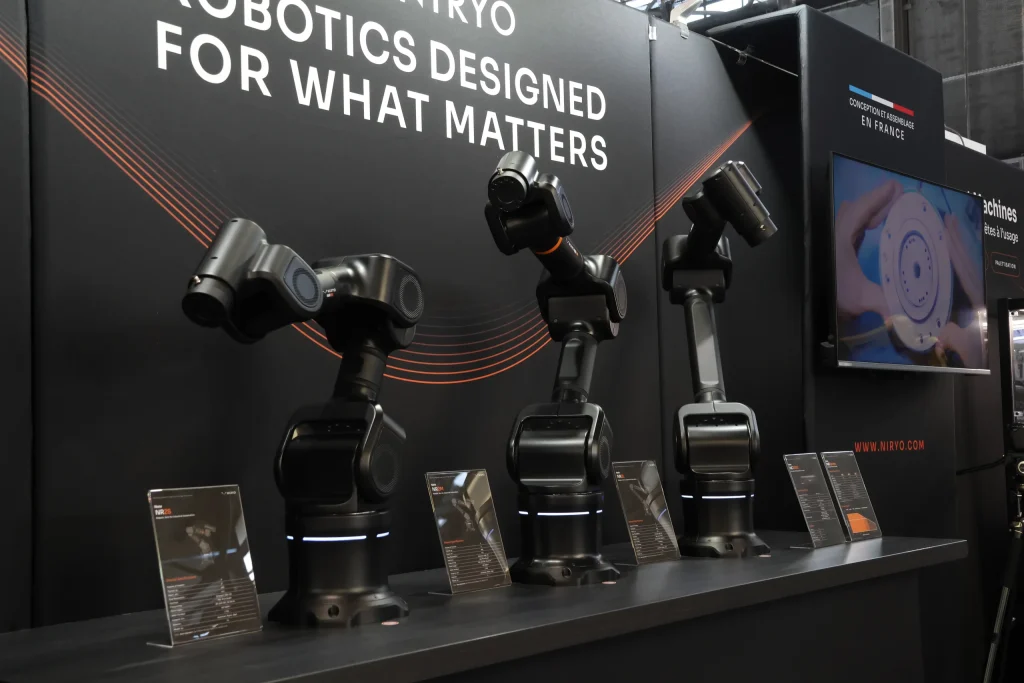

Global Industrie 2026 marked an important milestone for Niryo. For the first time, we unveiled Nate (Niryo to Automate), our new modular industrial robotics platform designed to address today’s automation challenges.
Beyond the product launch itself, the event gave us the opportunity to engage with a wide range of manufacturers and industrial companies. Those conversations reinforced a simple observation: industrial requirements are evolving rapidly, while existing automation solutions often struggle to keep pace.
Addressing Increasingly Complex Manufacturing Environments
Today’s production lines face growing challenges:
- Shorter product life cycles
- Fluctuating production volumes
- Increasing demand for flexibility
In this context, traditional automation approaches are often slow to deploy and difficult to adapt over time.
At the same time, advances in artificial intelligence are creating new opportunities.
Yet on the factory floor, adoption remains limited. Many robotic systems rely on closed architectures that lack the flexibility and modularity needed to fully leverage these new capabilities.
Nate was designed specifically to address these two challenges through a new approach to modular industrial robotics.
The platform is built on a modular architecture composed of technology building blocks that we fully control: robotic arms, actuators, gripper systems, software, and embedded intelligence modules.
The goal is straightforward: enable faster development of automated systems that can evolve alongside operational needs.
Smart Machines: The First Applications Built on Nate
At Global Industrie, we also showcased the first applications powered by the platform: Smart Machines.
These automated cells are designed to rapidly industrialize common manufacturing operations, including:
- End-of-line packaging
- Machine tending
- Selected sorting and quality inspection processes
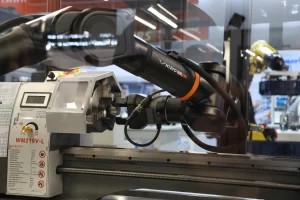
Smart Tending Machine demonstrating CNC machine tending at Global Industrie
Built directly on Nate’s technology stack, they combine standardization with a high degree of configurability.
Each machine integrates a robot, a gripping system, a safety enclosure, and application software.
Together, these components form a highly integrated solution that is ready for deployment.
Physical AI takes these systems beyond traditional automation. For example, machines can adapt to part variability or adjust their movements based on real production conditions.
This enables automation of applications that have historically been difficult to automate reliably.
👉 Explore the first Smart Machines of the Nate product range
An Open Platform Bringing AI into Industry
Beyond its industrial applications, Nate was designed as an open robotics platform.
Its purpose is to allow other companies to leverage its technology building blocks to develop their own solutions.
By providing access to key components, including actuators and software interfaces, we enable companies specializing in artificial intelligence, machine vision, and robotics to build new applications more quickly on top of an operational robotics foundation.

This approach simplifies the integration of advanced AI models capable of interacting more intelligently with their environment. These systems can identify objects, adapt to part variability, and adjust their actions in real time.
As part of this strategy, we are already working with several technology partners to explore new industrial applications that combine robotics and artificial intelligence.
👉 Learn more about our approach to Physical AI
NR Series: A New Generation of Industrial Robots
At Global Industrie, we unveiled the first 6-axis robots from the NR Series, a new family of industrial robotic arms developed on top of the Nate platform.
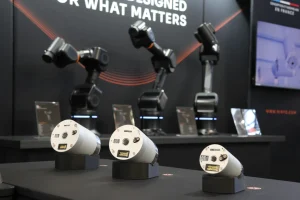
NA Series actuators and NR Series industrial robotic arms on display at Global Industrie
Built around a modular and open architecture, the NR Series enables faster development of robots tailored to a wide range of industrial applications while making it easier to integrate new technologies.
This approach also accelerates product development. By leveraging the shared technology building blocks of the Nate platform, our teams can design and prototype new robot configurations in just a few months, allowing us to respond quickly to market needs.
The event also provided an opportunity to showcase the prototype of our new N32 actuator, which paves the way for future robots capable of handling payloads of up to 20 kg.
These developments unlock new opportunities in palletizing, material handling, and other heavy-duty industrial applications.
Building a Sovereign Robotics Industry in Europe
Global Industrie was also an opportunity to reinforce a strong conviction: robotics has become a strategic technology.
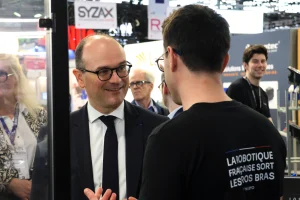
We had the opportunity to discuss this vision with Sébastien Martin, French Minister Delegate for Industry, during his visit to our booth.
Our conversations focused on a critical topic: the role of robotics in strengthening France’s industrial competitiveness and technological sovereignty.
On the show floor, that message was also reflected in a slogan displayed by our team: «la robotique française sort les gros bras ».
Beyond the slogan, our ambition is clear: help build a sovereign French robotics industry capable of mastering its key technologies, rapidly evolving its solutions, and addressing the challenges facing modern manufacturing.
By controlling every core building block of the platform, we aim to make robotics more accessible while strengthening local technological expertise.
This ambition extends beyond Niryo itself and contributes to the development of a broader French and European robotics ecosystem.
👉 Read our article “Modular Robotics as a Strategic Driver of European Technological Independence”
The launch of Nate at Global Industrie marks an important milestone for Niryo, but more importantly, it marks the beginning of a new chapter.
The first systems will become available in the coming months, with the goal of turning this platform into real-world industrial deployments that address practical manufacturing challenges.


