

 EN (€EUR)
 Support
  Contact
  My Quote



 Sign in

Artificial intelligence is entering a new phase. After transforming software and reshaping the way we work, it is now moving into the physical world: robots, industrial machines, autonomous equipment, and automated infrastructure.
As a guest at Capgemini’s Physical AI Summit in Madrid, Niryo joined industry leaders, technology providers, and automation experts to discuss a question that is becoming increasingly important across manufacturing and industrial sectors:
How do we move Physical AI from the lab to industrial reality?
Beyond the excitement surrounding the technology itself, discussions focused on the practical conditions required for adoption: business value, scalability, integration into existing industrial environments, and operational reliability.

Physical AI Summit – Madrid, June 3& 4, 2026
Several key trends emerged throughout the event. Trends that also reinforce the vision we share at Niryo: making automation smarter, but above all easier to deploy, more valuable, and more accessible.
An Ecosystem Coming Together Around a Common Goal
One of the most striking takeaways from the summit was the convergence of stakeholders that, until recently, often operated in separate ecosystems.
Robot manufacturers, AI specialists, edge computing experts, system integrators, and industrial organizations are now working toward the same objective: turning Physical AI breakthroughs into practical applications that create measurable value on the factory floor.
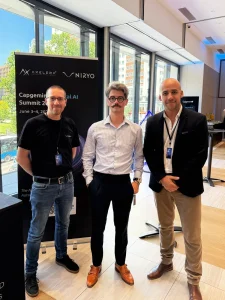
Julien Perrin, COO at Niryo, Marc Blanchon, Head of Physical AI at Capgemini,
and Jean Vieville, Director of Channel & OEM at Axelera AI, at the Physical AI Summit in Madrid.
This diversity highlights one of the industry’s biggest realities: no single company will build the next generation of automation alone.
Industrial companies define operational challenges. Technology providers develop AI capabilities. Robotics manufacturers build the platforms that bring those capabilities into the physical world.
System integrators connect everything together to create solutions that can be deployed and operated at scale.
As Julien Perrin, COO of Niryo, explains:
“What makes this event particularly valuable is the convergence of robotics hardware, software, computing power, and end users. Bringing together companies with real industrial challenges and those developing the technologies to address them is essential to building smarter and more effective automation. This collaboration is where Physical AI truly takes shape.”
Today, collaboration between robotics, AI, integration, and industrial experts is emerging as one of the key drivers for accelerating Physical AI adoption and turning innovation into tangible business outcomes.
Trend #1: ROI Remains the Ultimate Benchmark
If there was one clear consensus throughout the summit, it was this:Innovation only matters when it delivers measurable impact.
Industrial companies are willing to experiment.
They recognize that Physical AI unlocks new automation opportunities. They are prepared to test, explore, and sometimes take calculated risks.
But the final question is always the same: What is the return on investment?
A solution may be technologically impressive. It may leverage the most advanced AI models available. Yet if it does not improve productivity, quality, or operational efficiency, adoption will remain limited.
This reality is reflected in Capgemini Research Institute’s report Physical AI: Taking Human-Robot Collaboration to the Next Level.
The top three expected benefits identified by executives are:
- Increased productivity
- Improved operational efficiency
- Enhanced quality and precision
In other words, the same factors that have always driven industrial investment decisions.
Physical AI is no exception.
👉 Read Capgemini Research Institute’s report: Physical AI: Taking Human-Robot Collaboration to the Next Level
Trend #2: Orchestration Is Becoming a Strategic Challenge
Another recurring topic throughout the summit was orchestration.
Today, the challenge is no longer simply making a robot intelligent.
The real challenge is enabling dozens, or even hundreds of autonomous systems to work together efficiently.
How do you update an entire fleet of robots?
How do you monitor operations from a single interface?
How do you coordinate multiple intelligent systems within the same manufacturing process?
This is precisely where many industrial automation companies are focusing their efforts: developing platforms capable of connecting production equipment and centralizing operational data.
As factories deploy more robots, autonomous machines, and AI-driven systems, the ability to orchestrate these resources will become a critical factor for scaling successfully.
The intelligence of an individual machine will no longer be enough.
Performance will increasingly come from the collective intelligence of the entire system.
Trend #3: Without Reliability, There Is No Adoption
Physical AI is generating significant excitement.
However, one message consistently surfaced throughout the summit: AI must be reliable.
Industrial organizations are not simply looking for intelligent systems.
They need systems that are predictable, dependable, and maintainable.
A solution that achieves a 95% success rate in a laboratory but cannot guarantee production continuity in a manufacturing environment will not create value.
Reliability therefore remains a prerequisite.
This is especially true in industrial settings, where production downtime, handling errors, or system failures can have significant operational and financial consequences.
Physical AI will need to prove its ability to perform consistently in real-world environments before achieving large-scale adoption.
Interestingly, these three challenges: business value, scalability, and operational reliability, are precisely the factors driving the development of next-generation robotics platforms for industry.
Niryo’s Vision: Making Physical AI Practical and Deployable
At Niryo, we fully embrace this pragmatic approach.
We are convinced that Physical AI will profoundly transform industrial automation.
But we also believe that its success will depend on its ability to solve real-world problems quickly and cost-effectively.
As Julien Perrin explains in Capgemini’s report:
“Physical AI is opening automation opportunities that were previously uneconomical. By shifting intelligence into software, physical AI allows us to use simpler, cost-effective hardware for tasks that once required complex and expensive machines.”

This shift is fundamentally changing how automated systems are designed.
Intelligence is no longer driven solely by mechanical sophistication.
Increasingly, it comes from software, AI models, computer vision, and a system’s ability to adapt to its environment.
We believe a new generation of robotic systems is emerging: mechanically simpler, yet dramatically more capable thanks to software-driven intelligence.
The goal is not to add complexity.
The goal is to create robots that are more adaptive, faster to deploy, and more economical to operate.
This approach reduces integration costs, accelerates deployment, and extends automation to applications that were previously difficult or uneconomical to automate.
👉 Learn more about our approach to Physical AI
Nate: A Robotics Platform Built for the Physical AI Era
This vision is exactly what drives the development of the Nate platform.
Our objective is not simply to build another industrial robot.
We are building a robotics infrastructure designed to support the next generation of intelligent automation applications.
The platform is built around several key principles.
An Open Platform for Unlocking the Potential of Physical AI
Companies developing AI technologies or robotic solutions can build directly on Nate’s technology stack.
Access to software interfaces, actuators, and robotics components simplifies the integration of advanced AI models and accelerates the development of innovative industrial solutions.
A Modular Approach
The NR Series is built on a common technology foundation.
Actuators, software, electronics, and embedded intelligence are designed as reusable building blocks.
This modular architecture enables rapid development of new robotic configurations tailored to emerging industrial needs.
Sovereignty, Cybersecurity, and Supply Chain Control
The rise of Physical AI also raises important questions around technological sovereignty.
As industrial data becomes increasingly strategic, maintaining control over the robotics platform becomes critical.
Niryo designs and manufactures its solutions in France while maintaining control over the entire technology stack, from hardware to software.
This approach provides:
- Improved traceability
- Compliance with European regulations
- Stronger data governance
- Simplified local maintenance and support
- Greater supply chain resilience
For industrial organizations, these factors are becoming increasingly important decision criteria.
Building Physical AI with the Industrial and AI Ecosystem
The future of industrial automation will rely on systems capable of perceiving, understanding, and adapting to their environment in real time.
Accelerating this transformation will require close collaboration between robotics experts, AI developers, system integrators, and industrial organizations.
At Niryo, we develop both Physical AI-ready robotics platforms and AI-powered solutions whenever they create tangible value for our customers.
We also collaborate with companies specializing in artificial intelligence, computer vision, and industrial software by providing the robotics infrastructure they need to develop and deploy their own applications.
The Physical AI Summit reinforced one conviction:
The question is no longer whether Physical AI will transform industry.
The real question is how quickly we can turn that potential into measurable business value.
And that is exactly where our work begins.


