

 EN (€EUR)
 Support
  Contact
  My Quote



 Sign in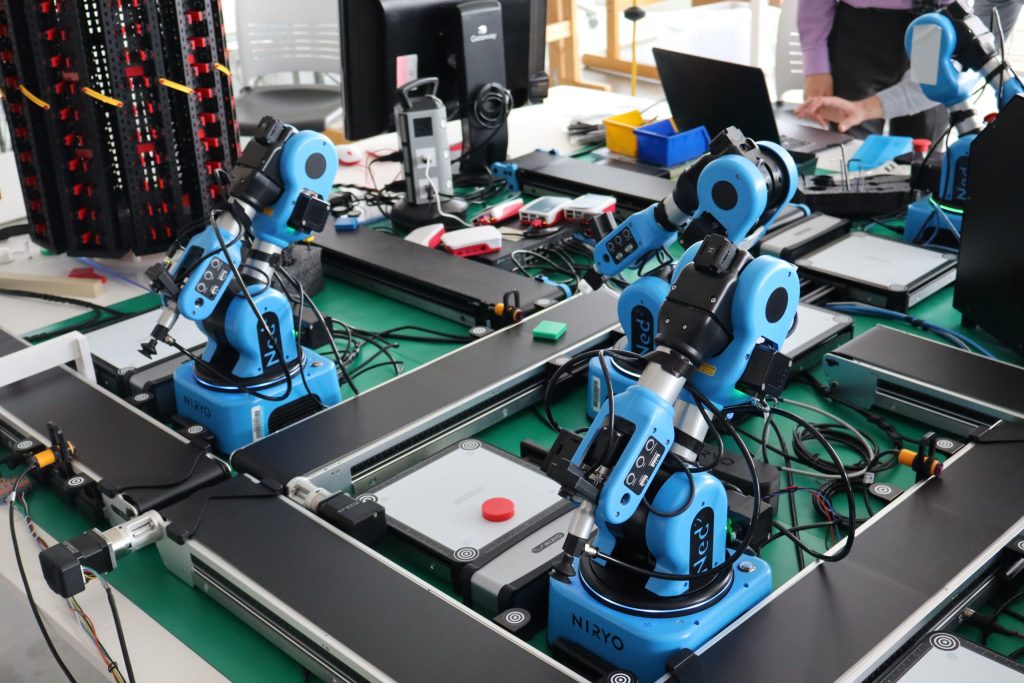

Did you know that as of 2024, more than 3.9 million industrial robots are in operation worldwide? This statistic highlights the growing role of robotics and automation in our society and economy.
Since its origins in manufacturing, robotics has significantly evolved, now impacting diverse fields such as healthcare, agriculture, and services. In light of this digital transformation, introducing robotics education at the high school level is not just relevant, it is critical to preparing students for the challenges and opportunities of the 21st century. This learning enables young people to develop key programming and problem-solving skills, equipping them for the workforce of tomorrow.
Developing essential STEM skills
Robotics is emerging as a powerful educational tool for cultivating essential STEM skills in students of all ages.
Programming and computational thinking
Through courses and hands-on activities, students learn to program robots using various languages, design algorithms, and build sequential logic.
This process cultivates computational thinking, a vital cross-disciplinary skill that enables learners to tackle complex problems, far beyond the realm of technology education alone.
Engineering and design
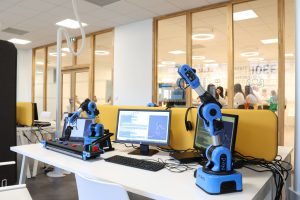
Educational robotics projects enable students to put the engineering design process into practice. Faced with a given problem, they identify the challenge, brainstorm as a team, design and build a prototype robot for learning (such as an articulated arm or mobile robot), conduct testing, and iterate to improve the design. This project-based approach emphasizes practical problem-solving and nurtures critical thinking, helping learners confront challenges encountered during real-world engineering tasks.
Mathematics and Applied Sciences
Robotics helps bring mathematical and scientific concepts to life, making them more concrete and engaging for students.
For instance, physics principles, such as motion, are directly observable when programming a robot like Ned2. Concepts like trigonometry become relevant for the navigation of more advanced robotic arms.
This hands-on application strengthens theoretical understanding of science and math, better preparing students for the digital and technological world.
Many schools now integrate robotics into their STEM curriculum, participating in national robotics leagues, using platforms like NiryoStudio to learn Blockly and Python programming, and training teachers through specialized professional development programs.
Fostering creativity and innovation
Implementing robotics offers a powerful platform to stimulate creativity and encourage innovation among learners of all ages.
Hands-On, experiential learning
The interactive, hands-on nature of robotics significantly boosts student engagement and motivation.
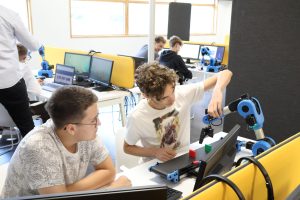
Educational robot kits like Ned2 turn teaching into a tangible and practical experience. Children, teens, and students are actively involved in building and programming projects, encouraging experimentation, initiative, and the development of key skills. Collaborative work on educational challenges also strengthens their teamwork and problem-solving abilities.
Solving real-world problems
Robotics can be used to implement solutions to real-world challenges, from automating simple tasks to assisting individuals with reduced mobility or monitoring environmental conditions. By working with robotic arms like Ned2, learners enhance their capacity to develop innovative and creative solutions to complex problems.
Initiatives such as national robotics leagues or school-based robotics classes allow teachers to deliver technology education in an engaging and pedagogically sound manner. These programs help prepare future generations for the digital challenges ahead, and Niryo’s educational packs make this hands-on learning easily accessible, thanks to streamlined delivery and classroom integration.
Preparing students for future careers
Today’s education must equip students with the skills needed to thrive in a rapidly changing job market, one increasingly shaped by technology and automation.
Growing demand for robotics skills
Demand for professionals skilled in robotics and automation is soaring across various industries. In manufacturing, programmable robots are increasingly used to enhance production and logistics, improving efficiency and cutting costs. In healthcare, surgical robots assist physicians, while in the service sector, delivery and support robots are becoming more common.
This growth means that skills in robot programming, maintenance, and design are highly valued in today’s labor market. Students who master robotics hold a clear advantage when seeking high-paying, innovative careers.
Robotics in high school: A springboard toward STEM higher education
Hands-on robotics experience gained in high school, through platforms like NiryoStudio or activities such as national robotics leagues, provides a solid foundation for pursuing higher education in engineering, computer science, and STEM fields. Learning to program, solving problems in teams, and manipulating robotic arms develops essential skills for succeeding in these disciplines.
Participation in robotics programs and working with accessible educational tools offers students a competitive edge in university admissions, demonstrating genuine interest and practical expertise highly valued by academic institutions around the world. Educators can rely on Niryo’s pedagogical packs to deliver these concepts in a way that is interactive, engaging, and fully integrated into classroom learning.
Robotics in high school: your questions answered
What is robotics in high school?
Robotics in high school is a hands-on approach to STEM education where students learn to program, build, and test robots such as robotic arms, mobile robots, or educational kits. It combines programming, engineering, and problem-solving in a practical, project-based format.
Why is robotics important in school?
Robotics helps students develop computational thinking, teamwork, and problem-solving skills while making abstract STEM concepts, like physics or programming logic, tangible and easier to understand. It also prepares them for careers in fields where automation and robotics are growing rapidly.
How can high schools start teaching robotics?
Schools typically start with an educational robot kit or platform, like Ned2, paired with a structured curriculum. Teachers can rely on ready-made lesson plans and progressive exercises, from basic programming to more advanced robotics projects.
Why choose robotics over other STEM activities?
Robotics is uniquely interdisciplinary: it combines programming, mechanics, and applied math and physics in a single hands-on project, making it one of the most complete ways to teach STEM skills at once.


