

 EN (€EUR)
 Support
  Contact
  My Quote



 Sign in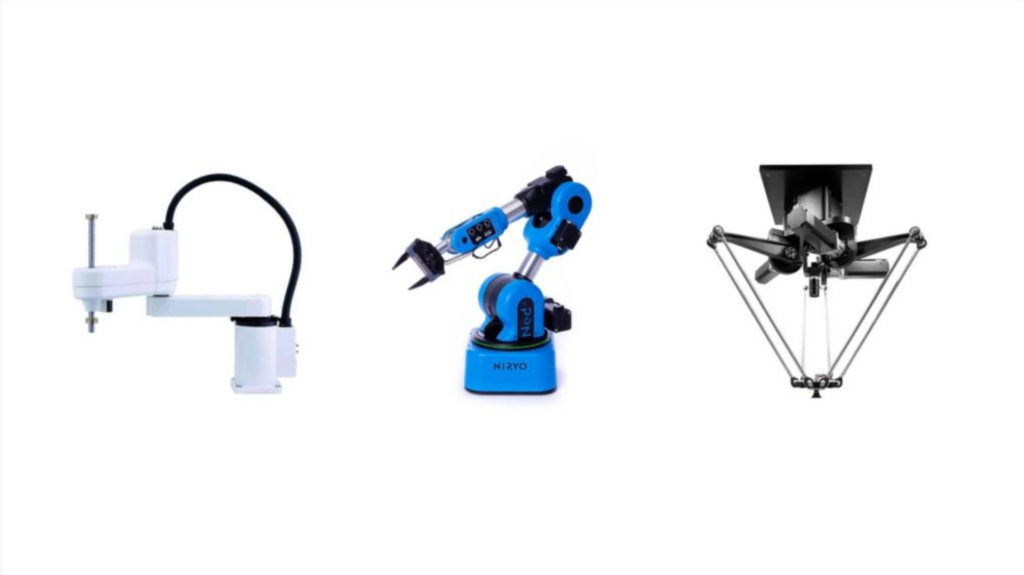

When it comes to educating the next generation of engineers and scientists, robots play a critical role in introducing students to automation and advanced manufacturing.
However, the struggle consists in choosing the right type of robot for classrooms, whether we’re talking about technical high schools or higher education such as engineering schools and universities. Three types of robots that are particularly well-suited for educational purposes are SCARA, Delta, and 6-axis robots.
In this article, we will be comparing and contrasting these three types of robots for educational use so we can help you choose the best according to your needs.
Before we start, let us define the aforementioned three types of robots:
Delta robots
Delta robots are parallel robots that consist of three arms connected to universal joints at the upper base. The key design feature is the use of parallelograms in the arms, which maintains the orientation of the end effector.

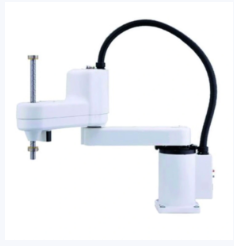
SCARA robots
The SCARA is a type of industrial robot that stands for “Selective Compliance Assembly Robot Arm” or “Selective Compliance Articulated Robot Arm”. Both can be found.
It’s commonly known for its high speed and accuracy.
6-axis collaborative robots
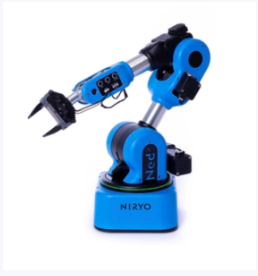
6-axis cobots such as Ned2 are a form of articulated robots that are known for their ability to perform an extensive range of applications, thanks to their flexibility, reach, and strength.
Now, let’s compare the three in terms of price, axis, speed, diversity of applications and open-sourceness.
Price: robots aren’t born nor priced equally
The cost of cobots can vary depending on various factors such as size, features, and complexity. According to recent market pricing guides, small Delta robots for education typically range from $15,000 to $30,000, SCARA robots from $8,000 to $20,000, and compact 6-axis cobots suited for classrooms from $2,000 to $8,000. As a general rule, Delta robots tend to be the most expensive of the three, while 6-axis cobots are often the most affordable for small-scale educational use.
Exact pricing varies significantly by manufacturer, supplier, and configuration, so it’s worth requesting a quote directly for your specific project.
Axis and flexibility
The number of axes a robot has affects its range of motion and precision. SCARA robots typically have three or four axes, which means they can move in three dimensions, but cannot rotate like a human wrist.
Delta robots have three axes and can move in all three dimensions, but have limited rotation. 6-axis cobots like Ned2 have axes that move across all six degrees of freedom, allowing for greater precision and flexibility.
Speed
Speed is an important factor to consider when choosing a robot. It affects the robot’s performance in different applications, and it can also affect how much time it takes to program the robot for a specific task. Unless the robot will be used for educational purposes, speed usually isn’t a crucial consideration. Adequate motors play an essential role here too.
The speed of each type of robot is measured by its cycle time (the amount of time between two consecutive movements) and acceleration/deceleration rate (how quickly or slowly it moves).
SCARA robots are the fastest of the three. Their higher speed makes them ideal for tasks that require quick movements, such as pick-and-place operations.
The precision of 6-axis cobots makes them equally suited for tasks that require accuracy, such as welding or assembly, and that’s also what makes them suitable for research and learning.
Diversity of Applications
Each type of robot has a range of applications for which it is best suited.
Scara robots are ideal for fast pick-and-place operations, assembly, and packaging, while Delta robots are well suited for tasks that require a large working envelope, such as sorting and inspection.
6-axis cobots are highly versatile and can be used in a wide range of applications, including welding, pick-and-place, and assembly.
Size and practicality
The size of a robot is important because it affects how versatile and compatible it is with different workspaces.
Delta robots are typically the largest of the three and require a relatively large workspace. There are also smaller versions of Delta cobots available, but their architecture, with the base fixed to a ceiling, makes it difficult to test a variety of applications and projects.
On the other hand, SCARA robots are typically smaller than Delta robots and have a more compact design.
6-axis cobots are available in a variety of sizes, but there are also small options available that are suitable for education purposes. An example of a small 6-axis cobot is Ned2, which has a footprint of just 200 mm x 200 mm, making it a good option for small classrooms or labs with limited space.
Ned2 is designed to be affordable and easy to use, making it a great choice for educators who are looking to introduce robotics to their students.
fait la suite
What about open sourceness?
Open source compatibility is an important consideration for educators who want to customize their robots or integrate them with other technologies. SCARA robots are the least compatible with open source software, while Delta robots offer some degree of open source compatibility. 6-axis cobots are typically the most open source compatible, with a range of software and programming options available.
For instance, Ned2 employs Raspberry Pi as its hardware and utilizes Python and C++ as its programming languages, in addition to ROS as its software. Moreover, our NiryoStudio application provides students with the opportunity to program the robot via Blockly, a visual programming language that can help them explore various aspects of robotics.
To conclude
Each type of robot offers unique advantages and disadvantages, making them suited for different applications. SCARA robots are the most affordable and fastest, making them ideal for pick-and-place operations and packaging. Delta robots have a large working envelope and are well suited for tasks that require a high level of precision. 6-axis robots are highly versatile and can be used in a wide range of applications.
For educators, the best choice will depend on the specific needs of their program, but 6-axis robots are likely the most versatile and adaptable option due to their open source compatibility and flexibility.


