

 EN (€EUR)
 Support
  Contact
  My Quote



 Sign in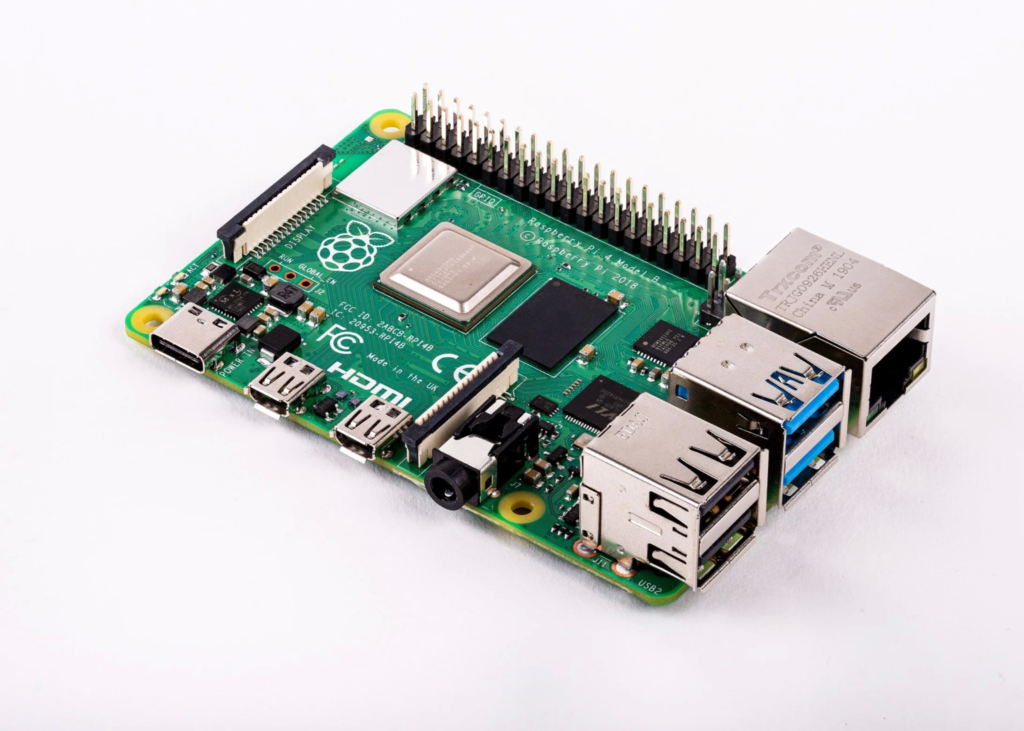

Engineering courses are notorious for their rigor and difficulty, and choosing the right materials can make all the difference. Today, limiting courses to textbooks and online resources isn’t enough. Students want a complete, hands-on engineering experience that gets them ready for the professional world.
The Raspberry Pi is a versatile and affordable single-board computer, widely used in robotics education. While the Raspberry Pi 5 is now available for those who need more raw power, the Raspberry Pi 4 model B remains a proven, stable choice for robotics projects in education, and it’s currently what powers Niryo’s own Ned2 robotic arm.
In this article, we’ll look at why the Raspberry Pi 4 is still a strong pick for robotics education, and how educators can use it to give students a more meaningful, practical learning experience.
Let’s start by defining Raspberry Pi
The Raspberry Pi is a versatile and affordable single-board computer that has been used for a wide range of applications, including robotics education. Thanks to its GPIO pins, processing power, and support for a full operating system, it’s particularly well suited to robotics projects.
Why is the Raspberry Pi a good choice for robotics education?
1. Raspberry Pi is affordable
The Raspberry Pi 4 is an affordable option compared to other microcontrollers and single-board computers on the market. This makes it an ideal choice for schools and universities with tight budgets. And even if you have a more important budget, we’ll tell you why it’s still a good choice for you.
2. Powerful processor and memory
The Raspberry Pi 4 is equipped with a powerful quad-core ARM Cortex-A72 processor, which can handle complex robotic applications with ease. On the other hand, it comes with up to 8GB of RAM, which provides plenty of memory for running multiple applications at the same time.
3. Large community equals large knowledge base
When professors and teachers choose material for their courses, they make sure there will be enough documentation for their students to explore, imagine multiple use cases and find answers to their never-ending questions.
The Raspberry Pi has a large and active community of users, which means that there are plenty of resources, tutorials, and projects available online to help students learn and experiment with robotics.
4. Raspberry Pi is about flexibility
Raspberry Pi is user-friendly and easy to navigate, even for beginners. This makes it an ideal choice for educators who want to introduce robotics to their students.
It also supports a variety of programming languages, including Python and C++. This provides students with flexibility in choosing a programming language that best suits their learning needs.
It has GPIO (General Purpose Input/Output), which are intensively used in the DIY universe, but are not limited to it.
Unlike Arduino, the Raspberry Pi has a variety of peripherals, including USB and HDMI ports, which can be used to connect to different devices and sensors, such as microphones, cameras, and sensors.
5. Versatility
The Raspberry Pi is a versatile device that can be used for a wide range of robotics applications, including desktop robots, mobile robots, drones, and industrial robots.
For instance, at Niryo, we utilize Raspberry Pi 4 to construct our six-axis collaborative robot arm! This approach allows students to dive deeper into the robot’s assembly and gain a better understanding of its inner workings.
Are there any limits?
Of course, everything has its limits, and the Raspberry Pi 4 has its own.
While powerful, it may not be suitable for extremely demanding robotics applications that require very high computational power, if you need that, the Raspberry Pi 5 is a better fit. But for most educational and semi-industrial use cases, the Pi 4 remains more than capable.
The Raspberry Pi 4 also requires some basic knowledge of programming and electronics, which may pose a challenge for absolute beginners.
Overall, the Raspberry Pi 4 offers a solid, proven learning experience and remains a great starting point to get anyone into robotics.


